Thursday, October 19, 2023

Teaching an AI/ML/LLM should be a distinct PurposeOfUse

I have been thinking about a specific need around AI/ML. That is, that when data are being requested/downloaded for the intent of feeding to a Machine Learning; this action should be distinguished from a request for Treatment.


This came up on a TEFCA/QTE call this week, where a question was posed as to how a patient could express that they wanted to forbid their data from being used to teach Machine Learning.

This use-case would need the above ability to understand when a data request could result in the data being used for Machine Learning. Note that data requests are encouraged to include ALL purposeOfUse values for which the data would be used. So in the USA, this would include Treatment, Payment, and Operations. (Note that it is known in the existing nationwide health exchange that many participants can't handle more than one, and thus in that exchange Treatment is presumed to be TPO. I don't like this, but reality is often less than perfect).

Thus, I think we need a specific PurposeOfUse to indicate these requests intend to be used for Machine Learning. I think that this PurposeOfUse would logically be a sub-concept of the existing Healthcare Operations. I argue this because it clearly is not about Treatment, or Payment; that is not to say that the resulting algorithms may not be used for Treatment or Payment; but the reason to ask/get data at this point in the data flow is to feed the Machine Learning. It might be argued that the Machine Learning Training PurposeOfUse would possibly be a new top level PurposeOfUse, but I don't think that is correct either as much of the data captured already today is presumed to be available for Machine Learning (best-practice is that it is consumed in de-identified form, but this topic is not about de-identification or not).

It is possible that we might need a new Obligation/Refrain code as well (thanks to Kathleen for pointing this out). Thus data could be communicated with an attached Obligation to not use it for Machine Learning Training (seems like a refrain). I don't mind putting this code in, but at this time Obligation/Refrain codes are not used, where PurposeOfUse is emerging as being used.

So a PurposeOfUse code specific to Machine Learning
  1. can be used in a response (bundle) to indicate positively the intended purposeOfUse allowed
  2. can be used in a request to indicate desired purposeOfUse -- which could be rejected if the responder disagrees
  3. can be expressed in a security token to indicate authorized PurposeOfUse
  4. can be used in policy rules to indicate permit/deny of that specific policy. In this way a data-use-agreement could state that the high level operations purpose of use is intended to enable all sub-concepts; and it could be used to indicate that the high level operations purpose of use is intended to ONLY speak to some sub-concepts such as eliminating the Machine Learning as being allowed or requested.
  5. can be used in a Consent, where allowed, to allow an individual patient to express rules specific to that purposeOfUse.
  6. can be placed on a dataset that has been properly gathered with that purposeOfUse
  7. can be placed on a data item within a dataset to indicate that the data has been properly gathered with that purposeOfUse 
    • note tagging the dataset is more common, as replicating the tag millions of times over at the data resource level is not adding value, but I express this one as a dataset might be a mixture of some data that was collected with authorization and some that were not. this would require tagging each data resource.
I would like to get wider consensus on this(these) concepts before we add a code. This consensus would also help inform what it is called, what it is described as, where it is placed, etc. I am confident that we have healthcare standards infrastructure to support this new use-case.

Friday, October 13, 2023

Test Interactions in a Production Environment

I covered how to include Test data in Production Environments using the HTEST tag. That article explained how data that is not real patient data, that is to say 'test' data, would be tagged with HTEST. This is a clear indication of what data in the Production Environment is test data vs not test data. Thus enabling clients to test while connected to the Production Environment, vs having a second environment just for testing. Where having a second environment may still be useful, but the switching from test server to production server can result in errors, usually configuration errors. So being able to do some form of testing in the Production Environment is useful, and testing with test data does not present Privacy concerns.

What that article did not cover is how a client indicates that it knows that it is testing. This has been part of some discussions lately.

Test Patients

First, there could simply be a list of well-known test patients. A request for a test patient is clearly a "test". However, agreeing on a list of well-known test patients is hard at a very large scale, like a nationwide exchange. So, this is possibly of limited use. It still should be attempted, even if other methos are also used.

Custom headers

Some have proposed that additional http headers be created for this 'testing' purpose. My worry about this is that the intention of testing in production is to get as close to exactly what would happen in production as one can get. Using well-known test patients is the least change. Adding headers seems to be very extreme. Further everyone would need to add to their infrastructure knowledge of these headers.

Getting everyone to add custom headers to indicate that a request is 'different' is not likely to succeed. Further, as custom headers it is less obvious when someone forgets to turn off testing mode.

PurposeOfUse

Best case is that the HTEST be used as a PurposeOfUse. HTEST does exist in the PurposeOfUse vocabulary, so it is ready to be used as PurposeOfUse in a request. In the previous article, I don't make mention that HTEST is a PurposeOfUse, but that was for simplicity of explaining things in that article. Data should be tagged with the PurposeOfUse under which it was collected, and test data is collected for the PurposeOfUse of ... testing.

So, add to your requested PurposeOfUse HTEST, and you are now signaling your testing purpose to the authorization and server environments. The big benefit of this is that it is clearly part of the security infrastructure, and secondly it is just one more PurposeOfUse.

Use of PurposeOfUse also is tracked into AuditEvents naturally as it is part of the security layer.

Note that HTEST is ontologically within HOPERAT. This is because it is for the purposes of healthcare operations that you are testing. Testing is not for the purpose of treatment; it is explicitly not treating as it is using test patients. Testing is clearly not payment, one would hope that the test patients will not be billed (well testing billing end-to-end flows would be useful, but it is still testing).

And HTEST can be combined with the normal treatment, payment, and operations so that one can cover flows that would be distinguished. Even combined with BTG (Break the Glass), yes Break the glass is a PurposeOfUse.

PurposeOfUse concerns

There are issues that have been brought forward on this use of PurposeOfUse:

1. Not everyone supports multiple PurposeOfUse. It is understood that some systems were designed back in the day when we thought that only "TREAT" was needed. These systems are really not using PurposeOfUse properly. One really should be asking for Treatment, Payment, and Operations; as it is very likely that any data returned will be potentially used for those other purposes. 

2. SMART App Launch does not include PurposeOfUse. Well, this is a problem that I tried to point out at the first and second revision of the SMART specification. Their failure to recognize the importance of PurposeOfUse is simply wrong. The argument that I heard is that the PurposeOfUse is confirmed during the User Experience at application authorization; and from that point forward just implied by the app client configuration. The SMART specification continues to need formal security modeling.

Note that UDAP, IHE-XUA, and IHE-IUA do include PurposeOfUse... and recognize that PurposeOfUse is multiple values.

Conclusion

Arguments that changing PurposeOfUse is hard really are not compelling to me when the alternative is to invent something totally new. If a change needs to be made, then make that change using standards. There is no good justification to ignore legitimate standards.

PurposeOfUse concept has not been tested well.. adding in HTEST will help get PurposeOfUse the attention it needs. The order should not matter; TPO, OPT, POT, etc. Including adding purpose of use codes that clearly should not be accepted, like "foobar".

Thursday, October 5, 2023

California Bill 352 - aka sex and gender sensitivity

The following question(s) were asked today, and I figure my response is informative to a broader audience.
Has anyone implemented anything pertaining to this?


Prevent the disclosure, access, transfer, transmission, or processing of medical information related to gender affirming care, abortion and abortion-related services, and contraception to persons and entities outside of this state in accordance to this part.https://leginfo.legislature.ca.gov/faces/billNavClient.xhtml?bill_id=202320240AB352

I'm trying to think through how to go about it and it seems challenging. These are some initial thoughts.Resources should use security labels. Which ones?
There should exist valuesets that define codes which are considered sensitive.. it doesn't seem like any exist
Access by a user/practitioner might not be as challenging because we may be able to determine the state in which the practitioner is practicing via an OIDC claim or a business identifier.. not totally sure about that
Access by a system is potentially more difficult... client registrations would need to contain some assurance about the locale of the application. Some may not segment application registrations in such a way
Access by a patient seems like it would be straightforward, but perhaps not. The patient has the unfettered right to see the data. But, what if a fhir-based app they use has server/architecture outside of ca?
Perhaps a scope could be introduced: "i-am-outside-of-ca", or "i-am-inside-ca"
Must we perform partial hydration of resources? For example, if a portion of the resource is sensitive. If the Patient resource cannot be accessed, the rest of the ecosystem can loose meaning
Documents, Binaries, eg CDAs - must generate a version "for CA" and another for "not CA"
HIEs, QHINs, ...


Mohammad Jafari and I have done work on this in DS4P and IHE-PCF; we continue to refine this as part of our technical advisory participation in SHIFT. -- https://www.drummondgroup.com/shift/

Grahame is correct that GENDER would be the most specific sensitivity policy code. This could be the code used to tag data that is sensitive to GENDER, although this is actually a policy code. A more general approach would be to use the SEX code which is a more proper sensitivity indicator. Whichever of these codes you use to tag data, would then be used in the Consent resource to indicate how those tagged data are to be protected.

In IHE-PCF I have a use-case that shows how this is done using the advanced option
https://profiles.ihe.net/ITI/PCF/content.html#3584-advanced

As to the question on "There should exist a valueset that define codes which are considered sensitive..."
I will reference you to the Appendix P in the IHE-PCF
https://profiles.ihe.net/ITI/PCF/ch-P.html#p5-security-labeling-service-models

First, there was one attempt at creating these value-sets... they were done by SAMSA, they are quite old and are not currently maintained. The SHIFT project is looking for some proper organization and governance to take on the task of updating and maintaining these.

However, no matter how perfect a value-set is; it will always need local tweaking to your organizations use of codes, and will not address use-cases of second or third order relationships.

On blinding part of a resource... you are correct that this is dangerous area. It is an area that we chose in IHE to leave to later versions of the IHE-PCF; we needed basic profiling done first.... Partial resource redaction is likely to be a very specific thing, I expect that partial redaction will first appear in the Patient resource itself. That is to say that the gender extensions may be something that blinding might be seen as still useful for specific users (e.g. the food service doesn't need to see this). When doing blinding like this, there is also the policy on how to indicate that the resource itself is not complete, where we do have the SUBSETTED tag that is used for use-cases like _summary; but in the privacy blinding to indicate that data has been redacted is to send signal to recipient... POLICY is going to be the hard part, the technical implementation can be achieved once a policy is defined.

On the client is within CA or not... WOW, very dangerous territory.. I suspect that this is more risky than even sub resource redaction.

Note that the Gender Harmony workgroup did have some discussion on this, and also chose to defer solving it at this time.
https://build.fhir.org/ig/HL7/fhir-gender-harmony/#out-of-scope

Conclusion

The fact that this is not well described has nothing to do with the technical capability, we have that ready. The main problem is defining comprehensive policies and addressing the risks to privacy, security, safety, and effectiveness. 

Very likely that this bill could be used to get a bunch of people together to define policy and profile how to make it work. Forcing functions are always critical to change.

I think that the SHIFT workgroup is in the best position to address this. They have a very broad participation that can best see the whole picture... and I am on that project.


Tuesday, September 19, 2023

IHE Basic Audit Log Patterns using #FHIR AuditEvent

The Basic Audit Log Patterns (BALP) is a Content Profile that defines some basic and reusable AuditEvent patterns.

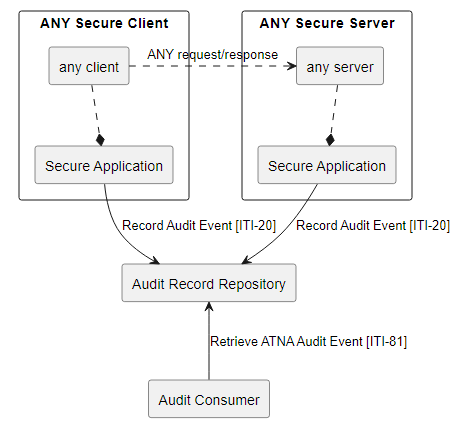
The Audit Log Patterns defined rely on the ATNA Profile for transport of the AuditEvent and query/retrieval of AuditEvents previously recorded. The patterns defined may be used as they are, or further refined to specific use-cases. Where a more specific audit event is defined, it should be derived off of these basic patterns. Thus, a more specific AuditEvent would be compliant with one or more of the AuditEvent patterns defined here.

This Implementation Guide is intended to be fully compliant with the HL7 FHIR specification, providing only use-case driven constraints to aid with interoperability, deterministic results, and compatibility with ATNA and other IHE Profiles.

ANY Secure Client and ANY Secure Server represent abstractions of any client/server actor grouped with an ATNA Secure Node or an ATNA Secure Application supporting the ATX: FHIR Feed Option, defined in the RESTful ATNA Supplement. Where ANY Secure Client and ANY Secure Server are involved in some communication that is an auditable event described in this Implementation Guide and for which some AuditEvent pattern is defined. The AuditEvent patterns defined here will be created and recorded [ITI-20] by the Secure Node or Secure Application that is grouped within the diagramed ANY Secure Client and the ANY Secure Server.

The double recording enables forensic analysis to detect failures better. Both audit events recorded will be different as the AuditEvent.source would identify the actor recording the event. Some actors will be able to populate the AuditEvent pattern given more fully, the lack of an element being populated is not a defect, but rather indicates that the actor did not have access to that data.
AuditEvent

AuditEvent Profiling

The AuditEvent resource is used to record that an auditable event has happened. These auditable events are usually security or privacy relevant, but may be for other purposes. The profiles of AuditEvent here are to support security and/or privacy use-cases. These profiles of AuditEvent can be used as is, or may be used to derive more specific profiles of AuditEvent for more specific use-cases.
Profiles

The following AuditEvent patterns are defined:
The following commonly used FHIR Servers have BALP implemented within them. You just need to turn it on. For more details:

Tuesday, September 12, 2023

HL7 Cyber Security Event - recordings available

 Announced this morning that HL7 and ONC are making available the recordings of the presentations given at the HL7 CyberSecurity Event. These presentations were very well done, and I encourage everyone to watch them all.

https://tinyurl.com/hl7sec

Wednesday, August 2, 2023

#HL7 #FHIR Security Education Event

Join me at the #HL7 #FHIR Security Education Event virtually this August 8 & 9! I'll be speaking on: 
  1. FHIR Security and Privacy for Developers
  2. FHIR Security & Privacy Capabilities
  3. FHIR Security Practical Application
  4. FHIR Consent: How to record, assert, and evaluate: IHE Privacy Consents on FHIR

See the full agenda and register at: https://info.hl7.org/hl7-fhir-security-education-event

Monday, June 5, 2023

Patient Requested Restrictions

 Many in the USA are reviewing and preparing comments on HTI-1. I used to do this top to bottom, but don't really have a work driver to base my comments upon. So I now end up reviewing and commenting on very targeted sections.

As part of my advisory position on SHIFT

Shift (formerly Protecting Privacy to Promote Interoperability PP2PI) was founded in 2018 and formalized in 2020 with a mission to advance safe, equitable, and patient-empowered sharing of health information. To this end, the task force has gathered expert stakeholders across the industry with the purpose of maturing granular data segmentation standards and implementation guidance in order to sponsor patient-driven sharing of health information with informed consent and advance interoperability in a more equitable manner. Shift’s vision is to further a health care ecosystem in which better standards for clinical data sharing increase trust between patients, providers, and caregivers to improve quality of care and health equity.

I am reviewing "§ 170.315(d)(14) - Patient Requested Restrictions Certification Criterion" and providing comments. The total things said in HTI-1 is

(14) Patient requested restrictions.

(i) For any data expressed in the standards in § 170.213, enable a user to flag whether such data needs to be restricted from being subsequently used or disclosed as set forth in 45 CFR § 164.522; and

(ii) Prevent any data flagged pursuant to paragraph (d)(14)(i) of this section from being included in a use or disclosure.


I have provided comments to SHIFT, and what they include is up to that organization. The following is purely my words.

First, I am very glad to see advancements in Patient ability to request and get the restrictions they desire. The state of the art in the USA is that Patients have next to nothing resembling Privacy Consent, all while their data are flowing to places that Patient would never imagine their data flowing.

However, I think that a regulation should focus on outcomes, not how to achieve those outcomes. Meaning the text in the regulation should be expressing the kinds of patient requested restrictions that must be allowed, and not expressing that a "flag" on data should be used. Why do I express this? Because systems design is very specific to the current systems design. Tagging all of the data in an EHR is non trivial, and there is not good advice on how to do that well, say nothing of how to do it without fail.

However, if we had expressions of the kinds of restrictions that are needed by Patients and express these in a prioritized listing; then creative systems designs can be done to achieve those goals. Some may choose to use data "flags", but some may find that their data already have attributes that they could leverage.

I have been working on a new Implementation Guide from IHE on this topic - Patient Consent on FHIR (PCF). And within that specification there is a set of steppingstones: Basic, Intermediate, and Advanced. The Basic is not easy, but is also not hard given many possible designs, and it is what is necessary to build both the Intermediate and Advanced alternatives. Advanced is using security sensitivity tagging, and is what is most of the time referred to as "Data Segmentation for Privacy (DS4P)". One can go directly to Advanced, and not implement the Intermediate. Intermediate is a set of use-cases that are high-value privacy consent needs, that do NOT require data to have security sensitivity tagging.

So, I would prefer that ONC change their (i) and (ii) clause to be expressing use-cases in terms of the resulting behavior and eliminate wording about how one must achieve that behavior.

I would be happy if ONC recognized the IHE-PCF, but it is just in Public-Comment right now, and thus is not ready to be referenced yet. It should be by the time they finish their comments.

 Preferences vs Consent

Another read of the HTI-1 is that there around the definitions in HIPAA for Patient Requested Restrictions and a healthcare organizations requirements under medical records retention and safety. HIPAA is very careful to give the right to patients to Request Restrictions, but then indicates clearly that the healthcare organization (Covered Entity) is not compelled to accept the restriction request. This has been used to keep the current status Quo where no restrictions are supported. I read the new ONC text to express a need to accept some of these restrictions. As I indicated above, if that was more clearly defined as to the kinds of restrictions that must be implemented, then it would be far more clear what is needed to be done here. 

Some other people have read the ONC text to demand that the healthcare organization must accept all restrictions without limits and without human intervention. I can understand this read, but I certainly hope it was not the intended read. 

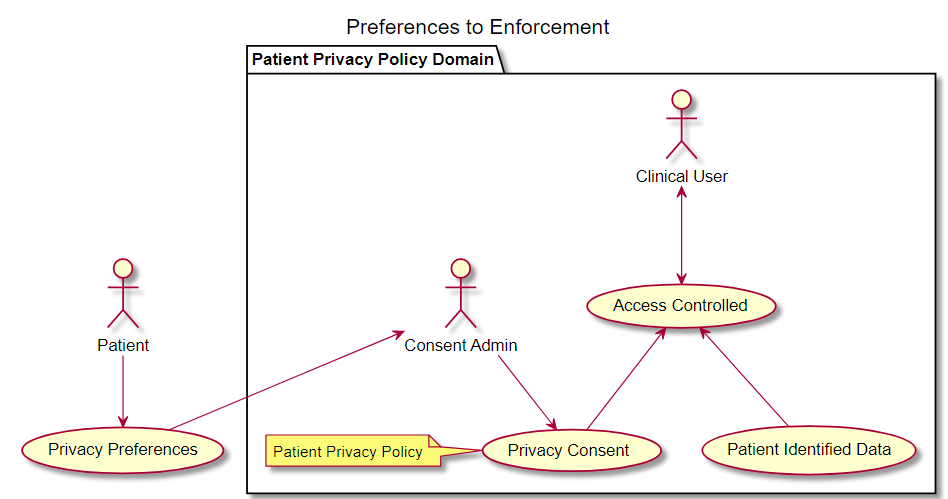
I have been working to express the distinction between the Patient Request, and the rules that an organization agrees to enforce. Where the Patient Request is referred to as "Privacy Preferences". Privacy Preferences would not be constrained by what is possible to constrain, although they might be in a structured and coded format. These Privacy Preferences could be taken as input to a workflow on Privacy Consent with an organization. The Organization here has responsibility to maintain the data, such as a treatment organization. The Organization has regulated responsibilities, like Medical Records Retention and Medical Safety. Thus the Organization has some limits on what they can restrict. The result is a Privacy Consent, where a Privacy Consent is a binding agreement between the Patient (or their delegate) and the Organization(s) holding data.  The following diagram is in the IHE-PCF Appendix P


Conclusion

There is so much more in the IHE-PCF that I can't cover here. The maturity of this specification would likely put it outside the window of what the ONC could reference, however the fact that it is in development should be seen as a positive move toward a future that has this kind of support. The real request to ONC is to change the wording of the requirements to not include "how" one achieves support for Patient Requested Restrictions, but rather itemizes the high value use-cases and the outcome of a system that supports those use-cases. This focus on "outcomes" and less on "how" will result in the solution sooner rather than later.