Showing posts sorted by relevance for query Provenance. Sort by date Show all posts

Wednesday, March 13, 2019

State of Healthcare Provenance today

Today, there is some provenance that is built into the Healthcare standards that are used. Some of this Provenance is not obvious, so let me expose it.

HL7 v2 has the least provenance information built into common use of the specification. This is not to say that there isn't provenance, but not much. In theory, one knows the sender of the message, but as a message, this sender information is usually discarded.

HL7 CDA has well implemented CDA header that holds Provenance. It isn't described as Provenance, but it is Provenance in that it describes: (a) Who authored the document, (b) What organization is the custodian of the document, (c) When was this document authored, and (d) Why was this document authored. Given that a CDA document is a document, and not a transport, it does not include to whom is it being sent, and from where is it being sent. These are gaps overall, but gaps that one should expect the transport to fill.

There is a CDA PROV specification, but it is not used today. This specification clarifies the basics, but also adds functionality for comprehensive Provenance within CDA.

IHE XDS/XCA/XDR/XDM/MHD is a document transport that is content agnostic. It can transport CDA, but it can also transport other content. With CDA, there is the above well defined basic Provenance. With other formats the document itself is not self declarative. Thus the XDS transports have defined metadata that explicitly carries these Provenance elements, along with other elements for other reasons (descriptive, identity, life-cycle, privacy, security, and exchange).

This metadata model was inspired by the CDA Header, but abstracted so as to work with any content type (which now includes FHIR  Documents), and many deployment models.
One Metadata Model - Many Deployment Architectures

Future on FHIR

FHIR has the most mature Provenance model. Not only does it have a Provenance Resource that can be used for any FHIR resource, but much of the Provenance data elements are often built into the core FHIR resource when that data element is fundamental to that FHIR resource. See the fiveWs page for details on this.

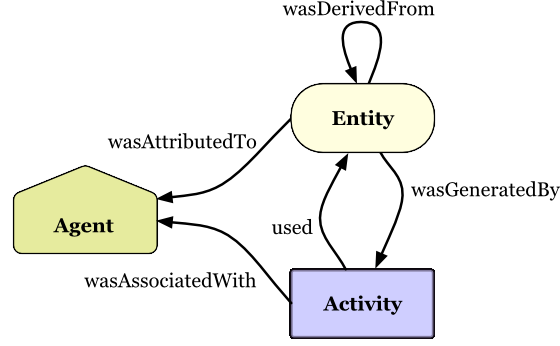
This model is inspired by W3C PROV, and long history in HL7 on Provenance. Thus it is intended to be comprehensive in function and ability.


FHIR Provenance Profile

There is a Profile of the FHIR Provenance resource to cover the use-case of data elements extracted from Documents that are shared in a Document Sharing (XDS/XCA/MHD) exchange, where the data are made available in Query for Element Data (e.g. Observations, Medications, Conditions, etc).  This use-case supports the case where someone is using the FHIR API to gain access to data, and they want to get the Provenance of the data they were given. Where the Provenance provides positive linkage to the Document(s) from which that data was extracted. See my webinars

Provenance Service vs Provenance with the Data

The CDA, XDS, and FHIR models defined above are all ways to carry Provenance with the data. This model is historically what is done in Healthcare, when Provenance is done at all.  The advantage of this model is that the Provenance data is conveyed with the data so that it is available when the data is used. 

However this is not the only model that could be done.

Provenance Service is a service that has the responsibility to support Provenance use-cases. When data are created, a record of that Provenance is submitted to a Provenance Service. When data are used, this service can be queried for evidence of Provenance on that data.

The FHIR Provenance resource could be managed in a standalone Service. A degenerate form of this Provenance Service in FHIR is where a FHIR Server that holds the clinical information also holds the Provenance. That is just a logical merging of the data custodian service with the Provenance Service.

The XDS model could be seen as a Provenance Service, much like FHIR. One can always lookup a document that you have in XDS to find a DocumentEntry. In that DocumentEntry is a hash and size of the document that you can confirm. There might be a digital signature association too.  If confirmed then you can look at the other elements in the DocumentEntry to see what the Provenance of that document is. Further one can see if the document has been replaced, transformed, or appended. This is not purely a Provenance Service, but the functionality does exist.

When is Provenance Created?

Simply whenever data are
  • created, 
  • updated, 
  • verified / authenticated, 
  • transformed / translated / derivedFrom, 
  • appended / amended, 
  • de-identified / re-identified,  
  • destroyed / deactivated / deleted,
  • exported / published / pushed,
  • imported
That is just about all actions other than Query and Read. Note all actions are AuditEvent relevant. Audit Log is not the same as Provenance. They are similar in what gets recorded and when a record is made; but the intended use and retention lifecycle of the AuditEvent is different than for Provenance. 

Having all of these records of Provenance is not valuable unless it is useful to those needing it.

When is Provenance needed?

The most important point of Provenance is that it is needed and used. A key part of use-case analysis is to look at the use of the data you are creating. If everyone created exhaustive Provenance records, but no-one used but 1% of those records, this would be wasteful.

So, lets look at Use-case for Basic Provenance


Wednesday, January 31, 2024

Provenance use in AI

I have been engaged in a few initiatives around AI/ML, both inside healthcare and broader. I have been engaged to work on a variety of different needs, that all use a variation of Provenance. The following is not a tutorial, but rather an outline of the various ways that Provenance is useful in AI. Useful is not to say that these are currently used.

  1. Provenance on dataset that is available for various uses, including being used as a learning dataset.
  2. Provenance on the learning dataset showing where each data came from. 
  3. Provenance on a ML model node showing which data influenced this node.
  4. Provenance on an AI output showing which nodes influenced this AI output (decision, observation, derivation, etc)
  5. Provenance on some action taken because of some AI output.
These steps are simplified and generalized. Especially inside of various architectures of AI/ML the concept of a node is not always identifiable. There is a push to use Provenance to enable explainable and trustworthy AI that would be able to explain why an AI output came to be. So, the above presumes that some node(s) in the knowledge model is identifiable.

These Provenance artifacts are also illustrated here purely as provenance details. That is to say that the Provenance does not carry the inputs or outputs; but certainly, points at them. Thus, one can't look to Provenance to embody the "AI Output", that AI output would be encoded in some other artifact.


I also speak of Provenance broadly. Within FHIR, the FHIR Provenance works fine. Outside of FHIR, the W3C PROV model works fine. But it is also possible that one has some other metadata structure that carries the artifacts of Provenance.

Provenance on dataset

This use of Provenance addresses the situation that those looking to teach an AI/ML, need data. The data may already be known, but there may be cases where one looks to a library of data looking for appropriate data. Where appropriate may include quality indicators, fit for use indicators, authorization rights. These are typical "Provenance What" attributes. As well as classic provenance attributes: Who owns the data, Where is the data, When was the data collected, Why was the data collected. 

The key here is to identify all the useful attributes that might be needed, and thus profile how that is expressed as part of Provenance. Some use-case needs:
  • How was this data collected? User questionnaire, Survey, Synthetic, Combination, Subset, etc
  • Is there a regulation covering this data?  Indicate the regulation
  • What region was this data collected within?
    • Is the data region locked?
  • Is the data about human subjects?
    • Is there subject authorization? 
    • Is the data de-identified? To what risk level?
  • Use obligations? Must be used in aggregation, must be de-identified, must get individual authorization, must be encrypted, etc
  • Allowed uses vs Forbidden uses?


Note that a source dataset may be derived from other source datasets. This is something that is key to Provenance. To be able to say this data is derived from that data using how methodology. In this way a Provenance can indicate that a dataset imports three other datasets. This said, the above What attributes would also need to be combined in appropriate ways. For example, I pull in three EHR datasets with de-identification that supports longitudinal consistency, and because the data are de-identified the original HIPAA regulation requirement is eliminated, yet the region covered is expanded. As such, there needs to be the ability to navigate back to the source of this derivation, but that pathway is likely privileged so not possible to navigate by all users.

Provenance on Learning dataset

This is very related to the Provenance on source dataset, but the distinction is that the source dataset doesn't always come with Provenance. But the learning dataset should know where all the data came from. Thus, the use-case need here is more classic Provenance holding simply where the data came from. This is not to say that one can't include the full details, but would be unnecessary if one can navigate from the learning dataset provenance to the source dataset provenance. Being able to navigate from one kind of provenance to the other is a key feature of provenance.

If there is a specific obligation that comes with some source data, this might be traceable using Provenance as well. I would think a simplifying methodology would be to have the obligations managed independently, so that the obligations have their own Provenance back to the source of that obligation. In this way a learning dataset may have a functional obligation that is sourced from more than one source dataset. This is simply one obligation (rule) with many Provenance. 

Similar to the source dataset discussion around derivation from multiple sources. The Learning dataset would have a wholistic Provenance that expresses the derived state, in addition to Provenance on each of the datasets that were imported.

Provenance on ML node

I will use the concept of a ML node, as an identifiable portion of a ML knowledge model. If there is a very specific ML model concept of a node, this works for me, but I didn't intend only that. I also know that some ML models don't have identifiable sub-divisions of the model, in that case then Provenance will be only possible to the Provenance on Learning dataset. Thus, the concept that a ML node is not always possible, but it certainly is important to explainable and trustworthy AI. 

The details of how the node was derived from the identifiable data is likely to be less describable. But where it can be explained, that explanation can be recorded in the Provenance as a how attribute.

Provenance on AI output

An AI model will take some input against the current model and produce some output. This input, current model, and output; are clearly attributes for Provenance of that output. The key use-case here is to track that some output is attributable to AI, and attributable to a given model. Use-case would also then be able to tack these outputs based on a given model, thus if the model is found to be defective, then those outputs can be re-evaluated or put into question.

Here I first put some emphasis on output being a subject of Provenance, so let me be clear that Provenance itself is not a way to encode the output. As with all artifacts, Provenance presumes that inputs, outputs, agents, algorithms, etc; are all encoded in some relevant and good standard and are able to be referenced by the Provenance.

Provenance on Actions taken because of AI output

This is getting a bit beyond AI/ML, but one uses an AI/ML to do something, and that something is what I am referring to here. I simply indicate that Provenance is applicable here too. So that one can indicate that some action was taken because of some output from an AI.

Summary

Provenance is not the core of AI/ML, but the general concept of Provenance is very valuable to the use of AI/ML


Wednesday, March 13, 2019

Basic Provenance Use-cases

There is a project starting in HL7 to define an Implementation Guide for "Basic Provenance" for use with CDA and FHIR. The motivation for this project, as I understand, is to move the Healthcare industry from providing very little Provenance, to providing Provenance that provides some value.

From W3C PROV we get a very clear definition of Provenance:
Provenance is information about entities, activities, and people involved in producing a piece of data or thing, which can be used to form assessments about its quality, reliability or trustworthiness.

Why Provenance?

The reason to have Provenance is because down-stream the data you create will be used by someone for some reason, and they need Provenance so that they can rely on your data. The creation of Provenance is work that must be done up-stream, and the agent doing the work to create Provenance is not benefiting from the work they are doing to create Provenance. Emphasis that created Provenance is only needed down-stream a fraction of the time. 

So, what are the most valuable down-stream use-cases where Provenance is needed, so that we can assure that up-stream provides that Provenance. Thus the use-case analysis needs to start from the down-stream use-cases to inspire the up-stream work to be done. 

Up to now, most work on Provenance has been on the up-stream use-cases, trying to inspire them to create perfect Provenance. This has failed because the up-stream use-case gains nothing from recording or providing Provenance, and thus there is no apparent value to providing Provenance. Where there is not a clear value-proposition, there will not be implementation. 

Use-case for Basic Provenance:

We could start from an infinite set of use-cases where Provenance might be needed, but we would continue to not inspire upstream implementation. So we need a sub-set of the use-cases that are clearly valuable. 

The critical question I have today is what is the "Basic" set of use-cases where data Provenance is needed, but where it is not available.  The "Basic" set needs to be understood as a reasonable sub-set of the "Comprehensive" set of use-cases where Provenance could be used. This Basic set of use-cases is critical today to inspire the creation of Reasonable guidance that is clearly justified to be imposed. 

In Scope use-case
  • When I use data, I need to know the Provenance of that data so that I can assess the quality, reliability and trustworthiness.
    • Where data are created by my own organization, I can trust my organization mechanism (out-of-scope is managing Provenance within an Organization)
When data are not locally created:
  • When I import data, I need to know the Provenance of the data so that I can assess the quality, reliability and trustworthiness.
  • The data is asserted as authored by an Organization (In-Scope, assertions of Organization)
    • An individual or device is nice, but often impossible to assess quality, reliability, or trustworthiness of some other organizations individuals or devices. Thus this level of data is nice, but not useful. (Out-of-scope is identification of agents more refined than Organization)
    • The data within the data may be derived from, or copies of, data originally from a third Organization. (In-Scope, origin of data that is copied or used in derivations/transforms)
Thus In-Scope
  • When data are authored and exported to another Organization, there is a need to have Provenance of the authoring and exporting Organization 
  • When data are exported that contain data that are derived, or copied, from another organization, then Provenance to that original organization is given.
Provenance elements
  • What data 
  • Who Organization authored and exported
  • Accurate timestamps
  • Indication of Provenance action (DerivedFrom, Export, Import)
  • Reasonable mechanism to confirm data are authentic 
Not-In-Scope for Basic Provenance --> Advanced Provenance
  • Provenance use within an organization for their own data -- Organizations do need this for their own purposes, but would not need to conform to a standard.
  • Fine grain Provenance on workflow transitions or data lifecycle events
  • Fine grain Provenance actor more refined than Organization 
  • Transform methods or algorithms 
  • Digital Signature proof of Integrity 
  • Provenance on De-Identification or Re-Identification
  • Provenance on Delete/Destroy/Deactivate activities
Reference:


Wednesday, January 7, 2026

Tracking Patient Data Corrections

When data are corrected, especially when the Patient themselves reported that the data was wrong, there needs to be breadcrumbs left behind. Correction is a form of updating of data, but with the special need to indicate that previous data was in error. Some corrections result in the previous data being removed, while others result in the previous data being replaced with corrected data.

Therefore the needs to be a special indication of a correction Provenance, as distinct from a general update Provenance, with the following goals:

  1. So that future uses understand the past might have seen different data
  2. So that requests for data, especially from outside (e.g. HIE), can see that previous data has been corrected.

The recipient can then find if they have a copy or used the previous data, and take appropriate action.

I have this documented in an IG that has both FHIR R4 and R6 details

- ci-build for FHIR R4 - http://build.fhir.org/ig/JohnMoehrke/correction/branches/main/index.html

- ci-build for FHIR R6 - https://build.fhir.org/ig/JohnMoehrke/correction/branches/R6/index.html

Use-cases

  • A patient contacts their provider to report that there is some data that is incorrect. An investigation is done, and the data are found to be in error. The data is corrected, and a Provenance resource is created to indicate the correction.
  • A Quality Improvement process finds that some data is incorrect. An investigation is done, and the data are found to be in error. The data is corrected, and a Provenance resource is created to indicate the correction.
    • One possibility for this detection is an AI system that reviews data and finds potential errors.

Profiling

Recommended use of a Profile on Provenance to indicate corrections:

  • activity.coding: will be code FIXDATA from v3-ActReason to indicate that this Provenance is for a data correction.
  • reason.coding: can use a set of codes often associated with a correction.
  • recorded: will be the time the correction was made.
  • target: points at the resource(s) that are corrected.
  • agent: indicates who made the correction.
    • the Patient would be indicated here for corrections requested by the patient.
  • entity: indicates the records corrected.
    • entity.role=#removal points at the record being replaced or removed (if applicable).
    • entity.role=#revision points at the record being revised (if applicable).
  • textual reason can be in why in R6, or in activity.text in R4/R5.
  • evidence such as the request for the correction can be in basedOn in R6, or in entity with role=#derivation in R4/R5.

Examples:

  • Provenance removal resource documenting the removal of incorrect food allergy observation. This example does not point at a resource that explains the correction, such as a DocumentReference.
  • Provenance replacement Provenance resource documenting the replacement of an immunization record that was in error. This example includes a reference to a DocumentReference that explains the correction.
  • Provenance AI corrected Provenance resource documenting the detection of an error in FHIR data by an AI system. The original Observation that is error is removed, and a new AllergyIntolerance resource is created to replace it.
  • Provenance AI corrected with replacement Provenance resource documenting the detection of an error in FHIR data by an AI system, where the Observation was used to record a food allergy, but the AI system detected that this should have been an AllergyIntolerance resource instead. Thus the Observation is removed, and the AllergyIntolerance is created.
  • Provenance patient correction Provenance resource documenting a patient requested correction of their birth date.
  • Provenance revision correction Provenance resource documenting the revision of a Condition resource with corrected onset date. In this case the original Condition is revised. Thus the old version history/1 is indicated as revised, and the new version history/2 is indicated as the current version.

changes from R4->R6 Provenance:

  • In R6 basedOn would be used to hold the evidence for the correction. Where in R4 would use entity with role=derivation, and in R5 with role=instantiates.
  • In R6 patient element exists. Same in R6. R4 didn't have patient, so other methods would be needed to find all Provenance pointing at a patient's data.
  • In R6 why exists. This does not exist in R4 or R5. Sometimes the activity.text would be used for this.
  • In R6 and R5 authorization is a codeableReference, where in R5 reason is used to hold the PurposeOfUse

Discovering Corrections

To find all corrections for a specific patient, one can search for Provenance resources with Provenance.activity with the FIXDATA code, and where the Provenance points at resources related to the patient.

FHIR R5 and R6

In FHIR R5 and R6 there is a patient element on Provenance, making it easy to find all Provenance resources related to a specific patient. One needs to simply filter on Provenance.activity with the FIXDATA code.

GET [base]/Provenance?patient=[patient-id]&activity=http://terminology.hl7.org/CodeSystem/v3-ActReason|FIXDATA

FHIR R4

In FHIR R4 one needs to search for Provenance resources that point at resources related to the patient. This can be done by searching for Provenance with Provenance.activity with FIXDATA and where the target or entity.what points at resources related to the patient. Since either target or entity.what may point at resources that contain a patient reference, these cannot be combined in a single standard FHIR search query. Both chained searches must be performed and results combined client-side to find all relevant Provenance resources:

GET [base]/Provenance?activity=http://terminology.hl7.org/CodeSystem/v3-ActReason|FIXDATA&target.patient=[patient-id]
GET [base]/Provenance?activity=http://terminology.hl7.org/CodeSystem/v3-ActReason|FIXDATA&entity.what.patient=[patient-id]

Proposed FHIR Document section

I could not find an existing FHIR Document section that covers this topic. For example, in an International Patient Summary (IPS) this could be an additional section. In this way as new Cross-Community requests are made corrections would be communicated. This section contains information about corrections made to the patient's data, including details of the original data, the corrected data, and the reason for the correction. This information is provided to ensure data integrity and transparency in the patient's health record. I propose a new section:

  • Section code: http://loinc.org#77472-9 (Information integrity attribute)
  • Section title: Corrections to Data
  • Section text: Text summary of the corrections made.
  • Section entries: Provenance resources documenting corrections made to the patient's data following the correction Profile on Provenance.

Note that loinc code 77472-9 is "Information integrity attribute", which seems appropriate for this section. I am open to other code suggestions.

Conclusion

This is just my view on this use-case. I expect there is experience that might help refine. Please let me know.


🎁Note, this is one of those projects I do pro bono but would love if someone would care enough about it to contract with me. Sustaining the Work That Sustains Trust: Why I’m Seeking Support for Some of My Standards Efforts

Tuesday, March 8, 2016

Provenance vs Audit -- it is not a competition.

Provenance and Audit seem to be recording the same thing, therefore why do they both exist and further why are they different?

Much of my response is focused on FHIR, but the concept is broader too.

Theory

In HL7 we are trying to harmonize the historic healthcare use of Provenance and Audit, with a model of Provenance that is put forth by W3C. We must understand there is a theoretical Provenance concept that is primarily what W3C is focused on. Yes it has implementation models, I am not saying it isn't complete, however it doesn't have a HTTP REST model. So we need to build one. And we have.


Provenance is a record that describes entities and processes involved in producing, updating, delivering, or otherwise influencing resources. Provenance provides critical foundation for assessing authenticity, trustability, and traceability. Who authored and why, who updated and why, where were these changes, when were these changes, and what influenced these changes. When data is moved, Provenance tracks where the data came from. In W3C it also tracks who accessed, or where the data was sent.

Audit is broader including any Privacy or Security relevant event, not just actions upon data (Create, Read, Update, Delete). Audit is used to capture all actions upon data, but also actions upon other protected resources. The Audit log exists to provide evidence that a system is working properly, and thus is used to detect when it is not working properly. So it is used to detect failures in Confidentiality, Integrity, and Availability. So it is used to provide reports such as an Accounting of Disclosures.  See Guest Post: Use-Case - Security Audit Prompts Investigation 

Reality

We must understand that in FHIR, that Provenance theory has been distributed differently. Much of this because of the momentum of healthcare, meaning we must recognize our own legacy. Second because healthcare is so very tied to Provenance as a concept, it is not new to healthcare, it is found in all our standards going back many decades. In historical systems they have a view that Provenance and Audit log are simply part of the database. So we are not new to this concept domain.

There is a 'view' in FHIR, the W5 (Who, What, Where, When, Why) report shows, much of the purpose of Provenance (in medicine) is handled by elements in each of the clinical and financial resources. This doesn't mean an additional Provenance record can't exist, but it means that in those cases to create a  Provenance record is to duplicate the essential elements, which few will choose to do. BUT THEY CAN. The FHIR Provenance resource is there for those cases where an additional record is desired to cover the cases where an explicit record of provenance is desired.

The FHIR Provenance is only recording the provenance of a Create or Update; okay that isn't fully true as during a Transfer we record where it came from, etc. But Provenance is not there to record READ operations. The most likely use of FHIR Provenance is for import use-cases, to indicate where the data came from which might be different than the provenance information contained within the resource. FHIR Provenance also covers things like putting a Signature across the targeted resources. It covers explaining how prior-evidence (entities) were used. It allows for explaining who (agents) was involved in the activity that produced the update. Mostly it fits well within the FHIR model, leveraging FHIR representations of the target, agent, entity, location, etc.

The FHIR AuditEvent resource is there to cover more than W3C provenance covers when they say they cover audit. The AuditEvent can record any event, not just provenance relevant events. AuditEvent can cover any security or privacy relevant event, not just operations on data. The big one that we point out, just to prove the point, is that AuditEvent can record logon events, both successful and failed. This is helpful in healthcare where, unfortunately, many healthcare systems still do user authentication rather than using an enterprise class authentication service (e.g. SAML, OAuth, etc). AuditEvent is there to record Query operation, not something that is Provenance based. There are other events too. And like Provenance it fits well within the FHIR model, leveraging FHIR representations of agent, entity, location, organization, etc…

Breadth of the event is different.

Provenance record might be on a larger operation (activity), whereas there might be many Auditable 'events' that happened during that 'activity'. For example to create an Order for some procedure, the Clinician would have reviewed many parts of the record, would need to align with the Encounter, and might have needed to create a few ancillary resources that go along with the Order (like Specimen). There would be one Provenance record on the DiagnosticOrder (actually unusual as DiagnosticOrder contains all the Provenance they desire, but for argument sake), it would point at the evidence that Clinician determined important from the whole record she reviewed (difference in Provenance.entity from all the AuditEvents recorded).

The Audit log is designed to include many redundant recording actors making redundant records, so any action like a Create of a resource instance might result in many (usually at least 2) Audit log entries. This redundancy is part of the pattern used to see that a system is working properly. As such, the Audit log tends to need to be analyzed and pruned through various filtering, reporting, alerting, and offloading.

So, for every piece of Data there might be a Provenance record, or it might be contained within the Data. One Provenance record can point at many pieces of Data. The graph shown is just a visualization of the 'number of' entries of data vs entries of audit log vs entries of provenance records. It is not intended to be complete, but representative.

But for every access to data there will be an AuditEvent, including accesses to the AuditEvent record will produce another entry in the AuditEvent. And there are also AuditEvents for login, system-startup, system-shutdown, etc. Thus making AuditEvent the most popular Resource in FHIR.... by definition.,

Utility driven by Use

The biggest difference is in use-cases over time.

* Audit

  • is accessed by support staff such as Security Office, Privacy Office, and IT Office
  • is analyzed quickly, within minutes/hours/days.
  • it might get filtered and forwarded, reports might get made,
  • some of it might get purged, other moved to offline storage.

* Provenance

  • is accessed by clinicians, billing, quality, safety
  • it might not ever be referenced, as it an unusual situation that doesn't have the data
  • is part of the medical record, it lives as long as the data, and
  • it goes with the data (should).

Exceptions to that general pattern do exist. But they are exceptional cases.

Provenance and Audit are both critical

I hope I have explained WHY we are not just adopting the W3C Provenance model. It is a model, we are looking toward it as a good model. But we are building something for Healthcare, and using FHIR. So there will be differences.

"All models are wrong, some are useful."

Updated: March 9th, 2016 -- fix the last graphic to be a bar-chart to better show this as a visualization of the number of entries, not to be confused with a Venn diagram concept of the other charts. Also swapped the first two diagrams so that a diagram of my work was first, the second is from the FHIR specification.

Thursday, May 9, 2019

FHIR Security & Privacy activities

This is an update of what is going on in Security and Privacy in, and around, the FHIR specification. 

---------------tl;dr-----------------------

  • FHIR R4 includes Security Considerations classification
  • SMART-on-FHIR first flavor is Normative
  • Addition of X-Provenance and X-Consent http headers
  • GDPR assessment against FHIR indicates good coverage of needs in FHIR already
  • Maturing AuditEvent and Provenance to Normative by FHIR R5
    • HL7 Implementation Guide on Basic Provenance (CDA and FHIR)
    • IHE updated ATNA to include FHIR AuditEvent feed and query
  • Signature datatype not likely to be R5 normative candidate

-----------------Details -----------------------

Overall Security Considerations:

The FHIR R4 specification now has an overall Security Consideration Classification. This spans the whole of the FHIR specification such that each Resource is assessed into one of four buckets of Security Considerations: Patient specific, Other Identified Individual specific, Business sensitive, and Anonymous Readable. These are not mutually exclusive classifications, but rather a "tendency". That is to say that each resource could cover many of these classifications, but tends to fall into the specified classification. The main goal of the classification is to raise awareness that the FHIR specification covers use-cases other than just sensitive patient data. The Security WG set the initial assessment, but the owner of the Resource can re-classify.  Also, actual use will be context specific. There is nothing wrong with using the 'Patient" classified resources in a way that is fully anonymous because they are holding synthetic data.

GDPR driven activities:

The Security WG has done an assessment of FHIR in the context of GDPR. This has produced a white paper that is available informally today. The GDPR assessment has driven some of changes that are already in the specification, and is also driving some future changes or implementation guides. These things have not really started formally yet, but include :
  • consent decision service -- to enable a FHIR Server to ask a service for Permit/Deny on an otherwise authorized request
  • basic Privacy Authorization Consent IG to support freely given and informed privacy authorizing consent
  • erasure operation to support GDPR and Right-to-Forget

SMART-on-FHIR:

The SMART-on-FHIR specification is now published in the basic form that is compatible with the original Argonaut version. This base-lines the standard at this starting point. There is interest in opening up for the next more advanced form of OAuth token support. One method uses a JSON Scope encoding, thus enabling far more comprehensive and complex scopes.

Maturity toward FHIR Release 5:

The Security Workgroup is going to work toward getting Provenance and AuditEvent to Normative by Release 5 (R5) of FHIR (Approximately end of 2020). This will be enabled by two different projects.  The HL7 Basic Provenance Implementation Guide, and IHE Audit Trail and Node Authentication updates to support FHIR. Signature datatype is not likely to go Normative in R5, but likely will have some advancements.

Plan to Mature Provenance:

The HL7 Basic Provenance Implementation Guide is getting started, so there is no specific conclusions yet. That said, the goal of this project is to define realistic and effective guidance on implementation of Provenance in a cross-organizational health information exchange (HIE) for the purpose of Treatment (may be Payment). This project is not addressing the Provenance requirements for within an organization. This project is not addressing ALL possible use-cases for Provenance, such as supporting Clinical Research. The most important part of the scope of this project is to set requirements that are as minimal as possible, yet effective for supporting Treatment. Counter this against a comprehensive Provenance implementation that would likely have well over a dozen Provenance records for any one clinical object record. Meaning that in a fully advanced Provenance it is very likely that Provenance is 10x the clinical data.  This Implementation Guide will drive public comment ballot, comment resolution, improvement of the core Provenance resource, and testing at Connectathon.  This is the maturity steps that the core Provenance resource needs to approach Normative in R5.

Note there are some Implementation Guides that have included Provenance guidance and constraints.

Plan to Mature AuditEvent

The IHE Audit Trail and Node Authentication (ATNA) project will help mature the core AuditEvent resource in support of Normative in R5. The ATNA profile is one of the oldest profiles in IHE, but has seen a major change to add FHIR based interactions. Last year there was an update of ATNA to add a query one could make of an Audit Repository to support reporting and alerting such as a report for Accounting of Disclosures, Access Log, and to support investigation of security and privacy incidents. This year IHE has added a AuditEvent feed support to support FHIR based applications recording AuditEvents using http RESTful FHIR create. Thus now the ATNA profile has support for recording an AuditLog, and queries.  This is going through a Public Comment ballot in the coming months, and will be setup for testing at IHE Connectathon in the future.

Advancements since R4

Provenance has not changed much yet, although there is a related abstract Provenance service ballot going through the HL7 ballot process. This abstract Provenance service work may impact the FHIR Provenance resource, but no changes have yet been proposed.

Provenance X-Header:

In FHIR R4 there is a new capability that may not be as well known. When an app is creating a FHIR Resource (for example an Observation), that application likely has a very rich understanding of the context of the creation event, so could provide a Provenance. The historic way it could do this was to either create the Observation, then create the Provenance; or it could use a Transaction to send a Bundle with both the Observation and Provenance. These do work, but there is a question of making this more easy. So there is now a http "X" header that one can use in a simple RESTful create/update to also carry the Provenance. Thus a normal http RESTful create of a new Observation can carry the app's definition of the Provenance in the http header, while the Observation is in the body. 

Consent X-Header:

A joint effort with CBCP has moved to add an X-Header to support an app asserting that a FHIR Consent authorizes the request being made. This is a http "X" header that holds the URL to the FHIR Consent. The Server is not obliged to consider the Consent, but it may consider it. That is to say that the use of this "X" header will only enable actions that the access control protecting the data also agrees with. The prime use-case for this feature is to enable a real-time point-of-care capturing of a Consent from the patient that authorizes the interaction. Where prior to having this Consent, the request would be rejected, but with appropriate proof that an informed and freely given Consent would now enable access. A similar "point of care consent" interaction is supported in some Nationwide Health Exchanges such as CareQuality.

Signature:

The Signature datatype is receiving some interest. Given that the primary function of a digital signature leverages external Digital-Signature standards such as XML-Signature and JSON Signature. Thus we are not developing the technology of Digital-Signature. In the FHIR Signature Datatype, we are just exposing in a more friendly FHIR way some of the useful attributes about the signature. The Digital-Signature validation is done using the Digital-Signature standard. A new use-case that is driving some interesting new views is one that has a context of a Provenance "Service" that is managed independently from the Clinical repository. In this case a end-user may be using a clinical Resource and use a Provenance Service to discover the Provenance of that clinical Resource. In that case the Provenance is being managed independently from the clinical Resource and the pathway the clinical Resource was communicated; then the Provenance.signature does not need to be a non-repudiation, but can be a simple integrity check (e.g. sha256). See other issues on Signature. 


Thursday, September 18, 2025

AI use Transparency in Healthcare: Building Trust Through Provenance

I want to bring some additional visibility to a project I am involved in regarding AI transparency in Healthcare. The goal of Transparency is to be able to indicate when data in the Medical Record has been influenced by AI, this is an important goal to providing Integrity of the use of AI. 

The Challenge: A Spectrum of AI Influence

The goal of our project is to indicate the level of AI influence on medical data. This isn't a simple "yes or no" question, but a spectrum that includes:

  • AI-authored data: The data was created entirely by an AI.

  • AI-recommended data: An AI suggested the data, and a human approved it.

  • AI-assisted data: An AI helped a human in some way, but the human was the primary author.

To address this, we're using two key approaches: data tagging and provenance.

Data Tagging

With data tagging, this is simply a tag of the kind of interaction that the AI had with a data object. So it is not useful to explain the details of the interaction beyond a generalizable kind of interaction. This tag is however helpful as a flag for those who want to know when data was influenced. 

One use of a simple tag is to recognize that the object may be not original thinking. There might be recognition that data that has been influenced by AI might not be as useful to train future models. The tag might also be used simply to know that there is more details in a Provenance.

Provenance

With Provenance we can carry details about what AI, what version, what model, what prompt, what card, etc. The FHIR Provenance is a derivative of W3C PROV, reformed to the data encoding standard that HL7 has based on RESTful Resources. 

We are trying to reuse more general AI standards such as model-card, but find that there is a lack of consensus. I am confident that the HL7 group will use external standards as appropriate.

One might need to know this level of detail to understand the usefulness of the output. One might also use this Provenance to track down AI influence that may have been determined to be suspect or incorrect. This might find decisions that need to be reevaluated.

Element level, not just Resource level

Both data tagging and Provenance have methods of focus on the element level, rather than the whole Resource. For some resources the whole resource is all that is needed to be tagged or referenced, but for some more workflow specific Resources like CarePlan, there are some data within that might be influenced while the whole is not. So, this element level is supported by both Data Tagging and Provenance solutions.

Concerns with Provenance model

A concern I heard was voiced at the connectathon this weekend is that Provenance is hard to work with. I think this is just an educational issue. Provenance is different in that Provenance.target points at the resources for which it is describing the provenance of; and thus the targeted resource does not contain some evidence of the Provenance. There are a few solutions to this:

  1. Use the Data Tag to indicate that the data was influenced by AI, and this gives evidence that searching for Provenance might be useful. When the AI tag is found, one just searches for Provenance with a target equal to the resource you have.
  2. Put the Provenance inside the Resource. FHIR supports a concept of a Resource "containing" another resource. This is used when the contained resource can't stand alone, but can also be used where the outer Resource really wants to carry the inner Resource
  3. Searching for resources, one can use the "_revinclude" parameter to also include any Provenance. Indeed, _revinclude is defined for anything, but the example given is Provenance.

Developing Implementation Guide

The HL7 implementation guide is in development so I don't, yet, have a formal publication to point at. The CI build is -- https://build.fhir.org/ig/HL7/aitransparency-ig/branches/main/index.html

All of the above discussion is already included in this Implementation Guide.

I have other blog articles on AI controls 

Learning Dataset Provenance

Wearing a different hat, I was a standards expert contract with Data and Trust Alliance to help them define a Provenance standard for the datasets that are offered to be used as source-learning material. https://dataandtrustalliance.org/work/data-provenance-standards

Conclusion

These are developing, so please get involved to help us address your use-case and learn from your experience.